

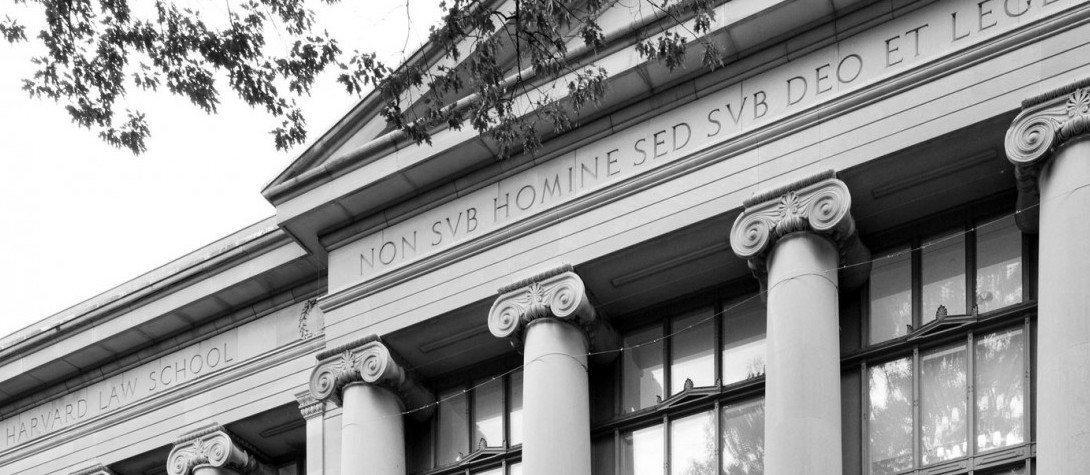
Etched above Langdell Hall, the symbolic heart of Harvard Law School where I’m currently a student, are the words: Non sub homine sed sub Deo et lege. Not under man, but under God and the law.
It’s meant to reflect a defining ethos—not just of Harvard, but of the legal profession itself: that lawyers serve as a bulwark against tyranny, an institutional backstop when power overreaches and democracy falters.
Yet every year, my school, like so many others, sends hundreds of its brightest graduates (myself included) to work at firms that have abandoned that very ideal. As Donald Trump pushes the boundaries of executive power in multiple directions at once—creating a series of rolling constitutional crises—BigLaw, the most powerful and well-resourced arm of the profession, has largely gone silent. That silence, in a moment like this, is complicity.
For many law students, especially those about to graduate and enter these firms, it’s disillusioning. We’ve always known, half-jokingly, that joining BigLaw meant some moral compromise. But now, as democracy teeters, the compromise feels existential. Trump has signaled a willingness to defy court orders, punish perceived enemies, and use the machinery of government to retaliate against law firms, universities, and private actors he believes oppose him. And yet the elite firms, the ones with the talent and influence to stand up, are largely standing down.
Still, many of us go to work at these very firms. Not out of ambition, but necessity. The cost of a top legal education is equivalent to a small mortgage. Public interest jobs, no matter how noble, can’t cover it. And the same schools that profess a commitment to justice often steer their most promising students toward the private sector, where the money is.
The problem isn’t that the next generation of public-minded lawyers doesn’t exist. They do. I know them. Brilliant, committed classmates who want to fight for civil rights, defend the vulnerable, and protect the rule of law. But they’re boxed in by a system that makes that path financially unsustainable.
If our legal institutions are serious about their role in defending democracy, then elite law schools have a responsibility to act. These schools shape the profession at its highest levels. They are backed by vast endowments and wealthy donor networks. They are uniquely positioned—and uniquely obligated—to make public service a viable option for those who want to pursue it.
That requires more than lofty speeches and glossy brochures. It requires real investment.
A Proposal: The Public Service Honors Scholarship
Imagine if the most prestigious opportunity offered at a top law school wasn’t a summer associate job at a V10 firm, but a full ride for students committed to public service.
Not just tuition. Everything: room, board, books, and fees.
In exchange? A five-to-seven-year commitment to public interest work—whether in legal aid, government, movement lawyering, or civil rights litigation. Break the commitment, and the funds convert into a loan. Keep it, and you graduate debt-free, with purpose, not just pedigree.
This program could be structured in one of two ways. Law schools could fund it directly as a declaration of their mission to uphold the rule of law. Or a coalition of donors—foundations, alumni, impact-minded philanthropists—could build a national fellowship that identifies the most promising candidates at elite law schools and gives them the financial freedom to serve.
It would be selective and prestigious—perhaps limited to the top 5% of each class, much like the Baker Scholar distinction at Harvard Business School. Students could apply during 1L year, with evaluations based on academic performance, public interest track record, pro bono hours, writing samples, and financial need. To remain in good standing, recipients would have to maintain strong grades and demonstrate an ongoing commitment to service.
Yes, many law schools already offer loan repayment programs for public interest graduates. Harvard’s Low Income Protection Plan (LIPP), for example, is specifically designed for this purpose. Graduates earning $70,000 or less can have their entire loan burden covered, with support phasing out up to $110,000. Participants can either remain in LIPP’s school-administered model, which requires annual reporting and direct subsidies, or opt into the federal Public Service Loan Forgiveness (PSLF) track, which provides full forgiveness after ten years of qualifying payments. Other top schools—Yale, Stanford, Columbia—offer similar programs.
But these systems, while well-intentioned, are structurally flawed. Most require a decade of public service before loans are forgiven. Some penalize spousal income or home equity, regardless of actual liquidity. Others shift eligibility rules without warning, making year-to-year planning nearly impossible.
The result? Even students who qualify often don’t trust the system. The programs are too opaque, too slow, and too uncertain. They don’t make public interest work truly viable. They just make it slightly less punishing.
What we need now is not marginal reform. We need a new model: one that treats public service as a career worthy of full institutional support, not as an act of charity or personal martyrdom.
The next generation of lawyers is ready. The question is whether our institutions are.
If elite law schools won’t meet this moment with bold action, they will continue to produce graduates who are either unprepared to confront the unraveling of the rule of law or complicit in that unraveling.