

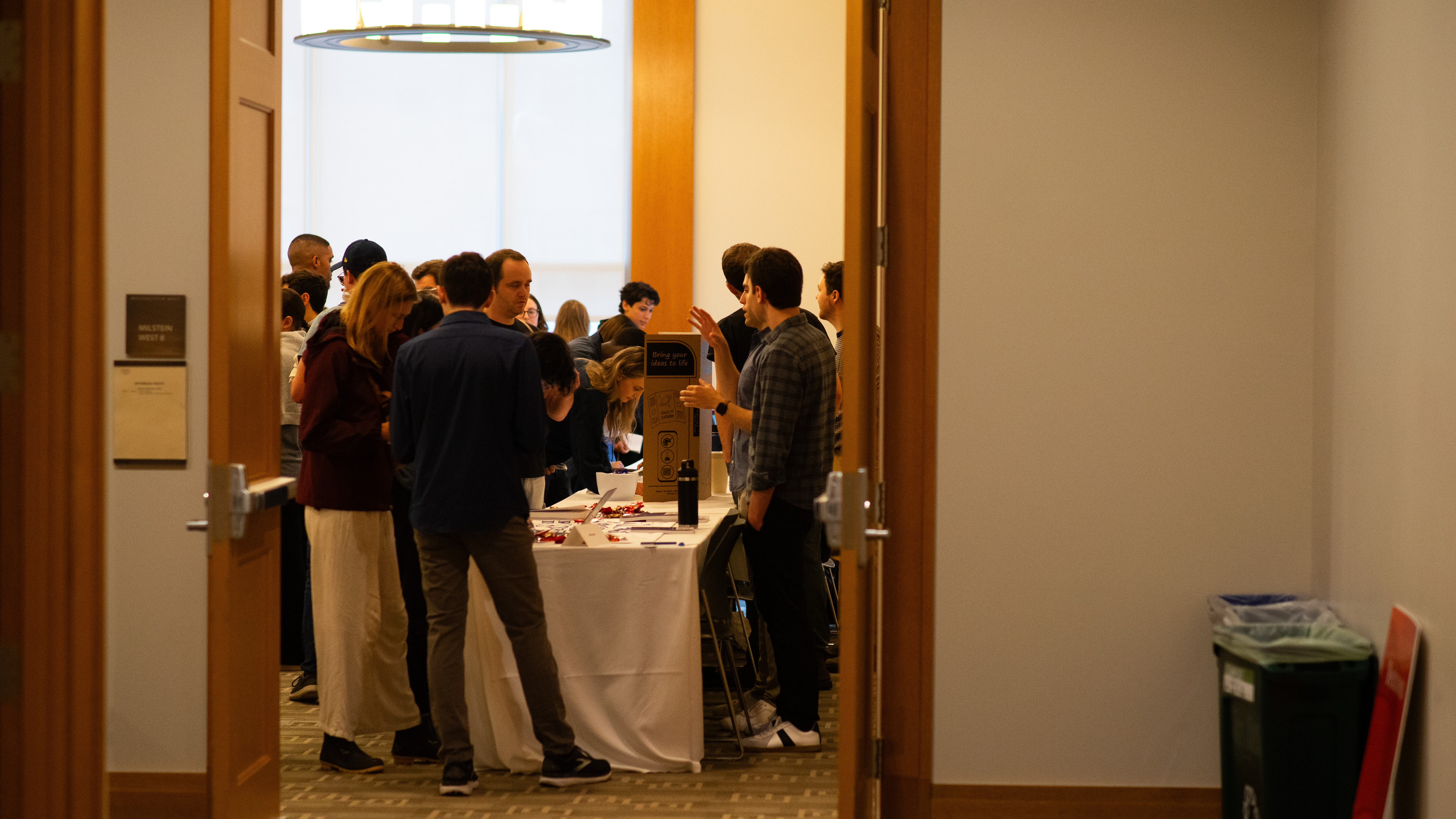
As the scholastic, career and recreational needs of the massive HLS student body evolve from year to year, new student groups spring up to meet these needs. Prospective student organizations must abide by a process outlined on the DOS-CEEB website. Applications must demonstrate that the group is meeting an unfulfilled need and has garnered sufficient student interest. New groups are reviewed by a committee containing members of the Student Government and DOS-CEEB starting in November, with final decisions announced in mid-December. Accepted groups are allocated $200-$250 in the spring semester, while rejected groups must wait another year to apply. Several students have already started to gear up for the process in the current academic year.
Mark Thomas, ‘26 has begun the groundwork towards creating a new student organization, still unnamed, that advocates for the Abundance movement. Thomas hopes to bring speakers to discuss land use and zoning, vetocracy and the administrative state, formats of community input such as notice and comment, and public infrastructure. The movement stems from the book Abundance, in which authors Ezra Klein and Derek Thompson propose a progressive movement that advocates for deregulation and criticizes failures of liberal governance. He hopes to cosponsor with other organizations that intersect those interests, such as the environmental law student groups, HLS Dems, and the AI Society. While Thomas has been attempting to contact DOS-CEEB to begin the process of founding the organization, he has faced difficulty in contacting the office over the summer. “I spent the summer emailing back and forth with CEEB trying to get an appointment only for them to keep saying ‘we’re busy this week, we’ll get back to you next week.’ Finally, they just told me to wait until school started.”
After soliciting the club idea among students, Thomas has received over 80 signatures from interested members. “It is validating that it’s not just me and that there is a decent appetite for discussions around abundances’ policies and legal implications or lack thereof.”
Michael Nevett, 2L, came to HLS with a desire to tap into pickleball. He garnered interest in his class-wide Slack for fellow interested students but quickly found a lack of access to publicly available courts. “I bought four rackets that are still in the shrink wrap because I couldn’t find a good place to play. At the Harvard courts, you have to pay $35 per hour unless you’re a GSAS student or Harvard College student. Clubs can reserve them for free.”
Nevett used his Slack channel to solicit interest in the official club and anticipates success in the approval process. “It seems like we are in pretty good shape to get chartered with the next batch as lots of people are interested. There’s an unmet need of a lot of people who want to play pickleball, so I am feeling optimistic about being able to do a lot in the spring like social events, casual games, and tournaments.” Before the club is officially approved, he hopes to partner with other student organizations to put on pickleball social events. He finds that DOS-CEEB has been helpful in their communications thus far.
Last year’s batch of approved organizations are now in their inaugural year of full funding and status. One such organization is the Harvard Law Run Club, which was founded by Jack Neary, 3L and several recent alumni. The Run Club puts on several weekly runs for all students who are interested in running, be it a recreational or serious endeavor. “We wanted to make a club that approaches wellbeing on a broad scale– social, emotional, and physical wellbeing. We want you to meet people you wouldn’t meet just from doing academic club,” said Neary.
The Run Club Treasurer Mark Sterling, 2L, emphasized how the central values of the group extend beyond the weekly practices. “When we found out someone was doing a race, there were efforts to get a group together to cheer them on. Our goal is to be a group of people who find community through running and who don’t take ourselves too seriously.”Practice Leader Cora Kim, 3L, hopes to dispel any fears that speed dictates membership. “There was this rumor going around that eight minutes is our easy pace – nothing could be further from the truth. No one is too slow; we want to run with you. I’ll be behind you in an emotional, but more importantly physical, way.”
“If you’re worried that it’s going to be super intense or people are going to run super fast or ditch you or we’re very serious, please just show up and we will prove that that’s not true,” says Neary. “We’re trying not to take ourselves too seriously and make a space that people are excited to join.”
To better serve an academic area with little representation in current class and club offerings, Renee Ramona Robinson, LLM’25, revived the nascent but recently defunct Harvard Art Law Organization (HALO). “There was an untapped need within the law school, which tends to focus on doctrinal things, and you don’t get to see creative aspects. The law is more than that. It involves politics, gender, and race; there are so many aspects that come about through something like art law.” Last year HALO put on a variety of events including attorneys from art law firms, museums, institutions, general counsel from a major auction house, as well as networking opportunities.
Robinson was disheartened by the turnout at one of HALO’s cosponsored events last year that dealt with narratives of carceral studies and business within the arts. Robinson noted that all of the panelists were Black women, and the event had the least attendance of the year. “It wasn’t billed as a ‘Black-focused’ event, so I found it kind of telling that there were five people in the audience,” she said. “Art law has a race issue, and that doesn’t go away just because you’re doing something cool and creative.”
Robinson has spun out her passion for art law into several related projects and organizations. She, along with Executive Editors Shira Fischer and Angus Taylor, launched the inaugural Harvard Art Law Review in July 2025. The school has not officially recognized the journal, nor has it accepted any new journals in recent years. Although Robinson said the Review will cease editorial production due to capacity issues, it will continue to publish Musings of the Month, which will include shorter articles and creative endeavors such as interviews and videos. “They are not the same as academic articles, but both have incredible value,” she said.
Robinson also founded the Harvard Fashion Law Association in the past academic year. This year will be the organization’s first year as a fully established student organization, having endured the probationary period. The Association hosted two events last year, including one featuring Justice Steven Breyer in a discussion about Star Athletica v. Varsity Brands, the primary fashion law Supreme Court case.
Robinson hopes the club can endure in its mission to represent the interests of creatively-minded students. “I would hate to see the arts, already an underdog that has to prove itself, fall prey to bad intentions. I hope that it stays in a successful bubble untouched by ego.”